

A quality retractable awning does a lot on its own. It shades your patio, protects your family from direct sun, and makes your outdoor space more comfortable during the hours when you actually want to use it. For many homeowners, that’s where the conversation ends — and that’s a missed opportunity.
The right accessories take a functional awning and turn it into a complete outdoor living system. We’re talking about a patio your family gravitates toward consistently, from a spring morning coffee through a late-October dinner under the glow of integrated lighting. One that closes itself when a storm rolls in, keeps the bugs out on a July evening, and stays comfortable when the temperature drops in September.
At Paul Construction and Awnings, we’ve been helping Greater Philadelphia and South Jersey homeowners design outdoor spaces for over 30 years. Accessories come up in nearly every awning conversation we have, because the homeowners who get the most use out of their outdoor spaces are usually the ones who thought through the full picture before installation. This awning accessories guide covers what’s available, what each addition actually does in practice, and how to think about building a setup that fits your family’s daily life.
Start With the Fabric: The Foundation of Your Awning’s Performance
Before getting into accessories, it’s worth understanding that the fabric itself is a variable — and a meaningful one. The awning fabric is the element your family sees every day and the component doing the most work in terms of weather resistance and UV protection. Choosing well here pays dividends across the life of the system.
Sunesta awnings, which Paul Construction and Awnings installs exclusively, are built around solution-dyed acrylic fabrics. The pigment in these materials runs throughout the fiber rather than sitting on the surface, which is why they hold their color and resist fading even after years of direct sun exposure. They’re also engineered for moisture resistance and outdoor durability from the start.
With over 100 fabric options available, the selection isn’t just aesthetic. Different fabrics perform differently in terms of heat reflection, UV blockage, and water repellency. A family with a west-facing patio that gets intense afternoon sun has different needs than one whose covered space sits mostly in the shade. That conversation is worth having before you commit to a fabric, not after.
Valance options round out the visual profile of the awning. A straight-cut valance reads as clean and contemporary, fitting naturally with modern exteriors. A scalloped or shaped valance softens the look and pairs well with more traditional architecture. The choice matters, but it also doesn’t need to feel high-stakes — our team walks through both function and aesthetics during every estimate so you’re choosing with full context.
Integrated LED Lighting: The Upgrade That Changes How You Use Your Patio
Of all the accessories available, integrated LED lighting consistently generates the most enthusiasm from homeowners who’ve experienced it. It tends to surprise people, in the best way.
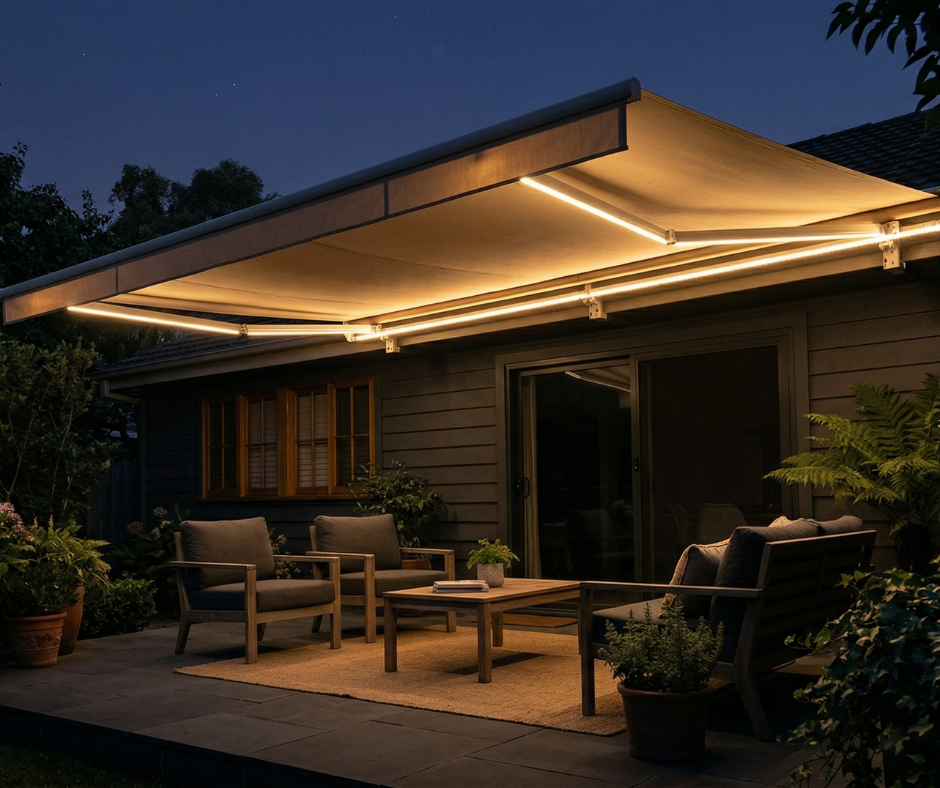
LED lighting mounts directly to the awning’s front bar or valance, casting warm, even light downward across the patio space below. There are no overhead fixtures to install separately, no extension cords running along the house, and no string lights to manage season after season. The result is a clean, finished look that makes the space feel intentional from the moment the sun goes down.
Practically, this one addition can extend your usable patio hours significantly. Dinner outside becomes easy because the lighting is already there. A gathering that starts in the afternoon carries naturally into the evening without anyone retreating inside for better light. The quality of that experience — ambient, directed light from above rather than glare from portable fixtures — is genuinely different from anything you can replicate with other outdoor lighting solutions.
LED systems designed for awnings are low-voltage and built to handle outdoor conditions year-round. Most integrate with the same remote or smart home system used to operate the awning motor, so the lighting and shade function as one cohesive unit rather than two separate things to manage.
Motorization: The Upgrade That Makes Everything Easier
If there’s one accessory that changes how often a retractable awning actually gets used, it’s motorization. Manual awnings are reliable — there’s nothing wrong with them — but the difference in frequency of use between a manual and a motorized system is consistent and significant.
With a motorized awning, the friction of use drops to nearly nothing. One button extends the canopy. One button retracts it. That immediacy means the awning goes up every time the sun angle shifts into the patio, every time a light rain moves through, every time the afternoon builds into something uncomfortable. Homeowners with motorized systems report using them far more regularly than those with manual cranks, simply because there’s no effort involved in the decision.
Paul Construction and Awning’s Sunesta retractable awnings are built around high-quality motor systems designed for quiet, reliable long-term performance. Standard remote controls handle most homeowners’ needs cleanly. For those who want more, the systems integrate with smart home platforms — more on that below.
Motorized and manual configurations are both available for different installation sizes and budgets. During your consultation, we’ll walk through which makes sense for your setup.
Wind and Sun Sensors: Protection That Runs on Its Own
A motorized awning responds to you. A sensor-equipped awning responds to conditions — even when you’re not there to respond yourself.
Sun sensors detect UV intensity and can extend your awning automatically when sunlight reaches a threshold you’ve set. When the light fades or clouds shift the exposure, the system retracts on its own. For families with kids in the backyard during the day, this kind of passive shade management has obvious appeal — the awning does its job without anyone thinking about it.
Wind sensors are arguably the most important protective accessory available. Retractable awnings are built for durability, but sustained high winds place real stress on both the fabric and the mechanical components. A wind sensor monitors conditions continuously and retracts the awning automatically when wind speed exceeds a preset threshold. This matters in Greater Philadelphia, where summer thunderstorms can develop quickly and catch an extended awning unprotected.
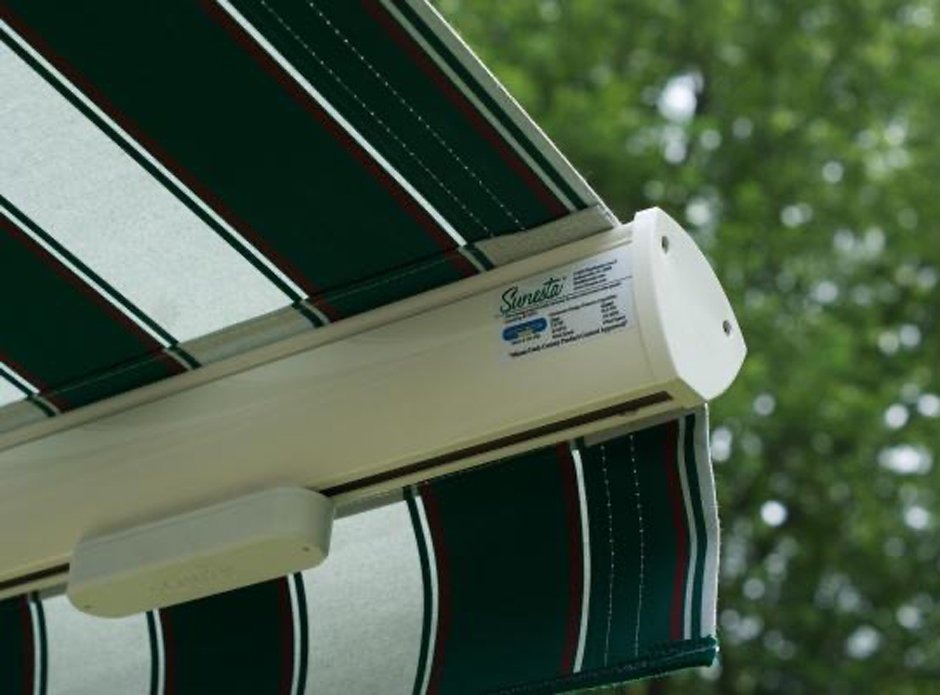
The value of that peace of mind is hard to overstate. You’re away from home, a fast-moving storm comes through, and the system handles it before any damage can occur. That automatic protection alone often justifies the cost of adding sensors to a motorized installation.
Retractable Screens: Solving the Problems Overhead Shade Can’t
Most homeowners focus on shade from above when they think about awning coverage. But afternoon sun comes from the side, insects come from everywhere, and wind doesn’t care about overhead structures. Retractable screens address all of that in ways a standard awning cannot.
Drop screens mount to the front of a covered area and lower vertically to create a partial or full enclosure at the open face of your patio. They’re available in a range of opacities: nearly transparent mesh that maintains your sightlines while blocking wind and UV, or denser privacy screens that create more of an enclosed-room feel. Retract them completely on beautiful days and the patio opens right back up.
Side screens work along the lateral edges of a covered space and pair naturally with front-mounted drop screens when you want more comprehensive coverage. Together, they transform a covered patio into something that functions like an outdoor room — protected from the elements and from insects, without any of the permanence of a full enclosure.
Retractable screens are particularly popular in a few specific situations:
- Porches facing a street, where privacy from passing traffic is a daily consideration
- Patios close to neighboring properties, where screening creates separation without fencing
- Spaces with consistent afternoon wind, where a screen makes a measurable difference in comfort
- Families dealing with mosquitoes, which are reliably active across Greater Philadelphia from May through September
Paul Construction installs Sunesta’s Sentry screen system, which accommodates widths up to 26 feet — wide enough to cover most patio configurations in a single panel. Custom sizes are built to the inch.
Smart Home Integration: The Full System, Connected
For homeowners who’ve invested in smart home technology, awning accessories fit naturally into the ecosystem already in place. Motorized Sunesta systems can connect to platforms including Google Home, Amazon Alexa, and Apple HomeKit, enabling voice commands, scene programming, and remote monitoring from your phone.
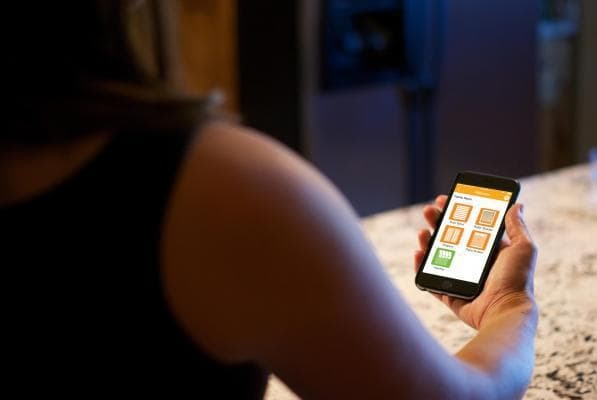
Some of the most useful applications in practice:
- Scheduling the awning to extend each morning at a set time and retract at sunset
- Creating a “patio mode” that simultaneously extends the awning, activates LED lighting, and adjusts other connected outdoor elements
- Checking your awning’s status remotely when you’re traveling
- Receiving a notification from the wind sensor before automatic retraction occurs, so you know what’s happening even when you’re not home
Smart integration is entirely optional. These systems work just as well with a handheld remote, and the majority of our customers are perfectly happy with that setup. But for homeowners who enjoy a connected home, awning automation fits cleanly into that framework without any awkward workarounds.
Building Your Setup Around How You Actually Live
The most useful way to think about awning accessories is as a system rather than a list of individual add-ons. A motorized awning paired with a wind sensor, integrated LED lighting, and a retractable screen isn’t a collection of extras — it’s a purposefully designed outdoor living space where each element solves a specific problem that the others don’t.
The right starting point is to observe your family’s patterns. Think about when you actually use your patio, what stops you from using it more, and what would change if those barriers were removed.
- If evenings are your prime time outdoors, LED lighting and heating belong at the top of the list.
- If wind or insects are the consistent nuisance, screens are the highest-priority addition.
- If you travel or simply don’t want to think about weather protection, sensors earn their keep quickly.
- If your family wants to push outdoor use into the shoulder seasons, heating changes the equation entirely.
Every estimate Paul Construction and Awning provides starts with a site visit and a real conversation about how you use your space. We look at sun exposure, prevailing wind direction, privacy considerations, and how your existing outdoor setup functions before recommending anything. The goal is a configuration that delivers the most value for your specific situation — not the most accessories for the sake of it.
Our awning and screen services cover the full range of Sunesta options, and every installation is backed by our Lifetime Workmanship Guarantee alongside Sunesta’s manufacturer warranties.
Schedule your free estimate and let’s build something your family will actually use.