

There’s a stretch every September in Greater Philadelphia when the patio feels almost perfect. The summer heat has eased, but bugs, cooler evenings, and sudden weather shifts can still send everyone indoors. Retractable screens and roof structures can help extend that outdoor season and get your family back outside.
Pennsylvania’s four-season climate gives every patio a natural end point each year—the question is how early it arrives. That can feel especially abrupt after a long, hot summer, when comfortable evening temperatures seem to disappear almost overnight. With the right additions, homeowners can push that end point back by weeks or even months and get more use from the space they already have.
It’s a familiar pattern across Skippack, Doylestown, King of Prussia, and the rest of Montgomery and Bucks County: a patio or deck that got heavy use all summer sits empty by the second week of September, not because the space stopped being nice, but because nobody wants to deal with bugs after dark or an unexpected downpour halfway through dinner. The same is true across the river in South Jersey, where Cherry Hill and Voorhees homeowners face the same drop-off once the bugs and evening wind move in.
The Two Things Actually Cutting Your Season Short
It’s rarely the temperature alone that sends people back inside. It’s bugs at dusk, wind picking up as the sun goes down, and the occasional rain shower that shows up without warning. Solve for those two problems — pests and weather — and a patio that felt done for the year in early September can stay in regular use well into October or November.
Retractable Screens Keep the Bugs Out and the View Open
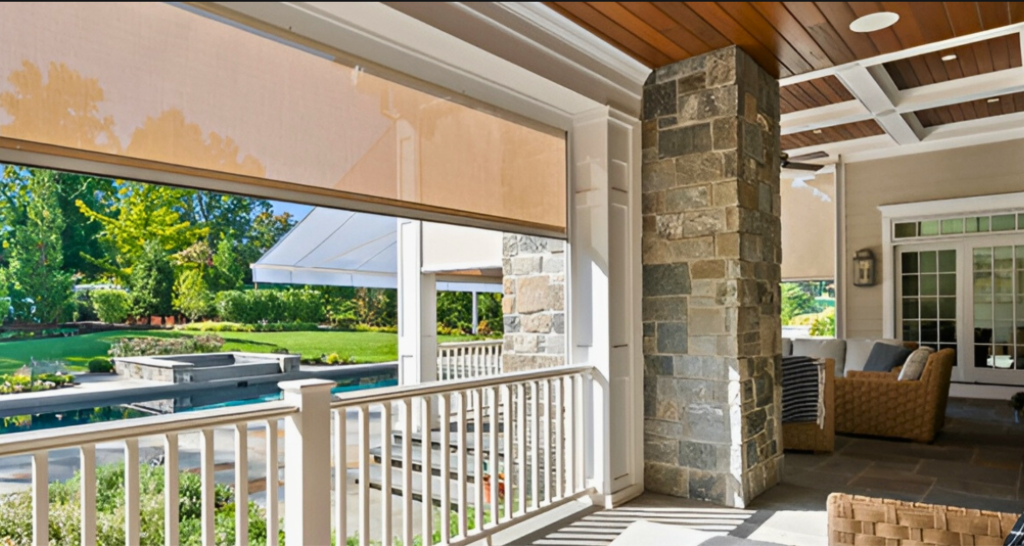
Sunesta Sentry Screens are motorized retractable screens that lower at the push of a button to protect a porch or patio from bugs and wind. Retract them for an open patio or deploy them for a screened-in space without the permanence or cost of a full enclosure. Available in mesh or mesh with clear vinyl panels, each system is custom-sized for porches, patios, and pergolas. Motorized operation makes them easy to use whenever conditions change.
How Sunesta Screens Compare to a Basic Screened Porch
A traditional screened porch is a fixed, permanent structure — once it’s screened in, it’s screened in year-round, whether you want the open-air feel back or not. Retractable screens flip that. On a warm, bug-free afternoon, retract them and the space reads as an open patio or porch again — no mesh, no frame in your sightline. When the bugs show up at dusk, or the wind picks up, lower them in seconds. It’s the flexibility of both spaces in one, without committing the whole area to a single use, and without the framing and permitting that a full screened-in addition usually involves.
Roof Structures and Covered Patios Add Weather Protection
Screens solve for bugs and wind. They don’t solve for rain, or for sitting under direct sun during the parts of the day it’s still strong. That’s where covered patio installation and post and beam outdoor structures come in. Post and beam roof structures work over an existing patio or as part of a new build, and they’re designed and engineered for the footprint of your specific space rather than adapted from a stock plan. Add a retractable canopy or built-in lighting and the structure works for shade in September, protection from an early fall rain, and a defined outdoor room the rest of the year.
Picking the Right Structure for Your Space
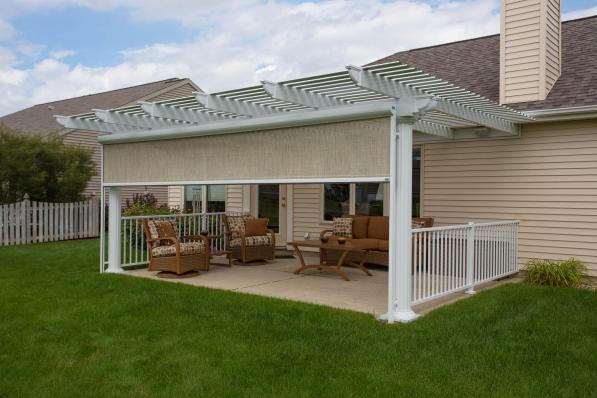
Not every backyard calls for the same kind of structure. A pergola, built from wood, vinyl, or composite, works well over a seating or dining area and can be fitted with a retractable canopy for adjustable shade, or built solid for consistent coverage. A full roof structure, using the same post and beam approach as our covered patios, makes sense for a larger footprint or a space meant to function as an outdoor room year-round.
Gazebos and trellises are a fit for a defined, enclosed feel in a smaller area, like a dining nook or a spot for a hot tub. Every one of these is designed and engineered specifically for your property rather than pulled from a standard plan.
Materials and Custom Options
Frame finishes come in a range of powder-coated colors to match your home’s exterior, and Sunesta screen and awning fabrics are available in more than 100 solution-dyed acrylic options, so the color and pattern can be matched to your patio furniture or your home’s trim rather than picked from a handful of stock choices. Every system, whether it’s a screen, a pergola, or a full roof structure, starts with a hand-drawn plan specific to your property, not a generic layout adjusted to fit.
Lighting and Small Additions That Stretch the Evening Further
Once bugs and weather are handled, the last thing that ends an evening outside is losing daylight. Built-in lighting can be integrated into a pergola or roof structure — whether that’s recessed fixtures, string lighting along the beams, or fixtures worked into the design from the start. It’s a small addition next to the screens and structure themselves, but it’s often what turns a space from occasionally used into the default spot for dinner most nights of the week.
Does This Work on an Existing Patio?
Both retractable screens and roof structures can be added to a patio that’s already there — neither requires starting over. Screens mount to an existing porch, patio, or pergola opening, and a roof structure can be engineered around a deck or paver patio already in place. For homeowners who put in a paver or travertine patio a few years back and are only now thinking about covering it, retrofitting is the more common project, not a new build.
Why Fall Is a Practical Time to Add Screens or a Structure
Scheduling this kind of project in the fall has another practical advantage. Permitting and engineering for a roof structure or pergola take time, and starting in September or October gives you a better chance of finishing before next year’s peak season instead of competing for spring installation dates. Retractable screens are a faster add-on, but pairing them with a structure project means both can be completed and ready together.
Combine Both for a Space You Can Use Into November
Pair a covered structure with retractable screens on the open sides and you’ve got a space that handles bugs, wind, sun, and light rain — most of what actually ends outdoor living in a normal Pennsylvania fall. For homeowners who want to go further and stay outside through the winter entirely, that’s the natural next step toward a four-season sunroom, but screens and a covered structure alone will get most Greater Philadelphia backyards well past the point where everyone else has packed it in.
What This Looks Like Month to Month
In September, screens help manage bugs and evening wind. By October, the roof structure keeps rain and cooler afternoons from ending time outside. By November, the combination can keep a backyard in regular use well past the usual season. With no mechanical heating or cooling required, there is also no added utility cost.
Screens and Covers vs. a Full Remote Space
Not every backyard needs — or has the budget for — a full Remote Space conversion with heating, cooling, and motorized walls. Retractable screens and a covered structure solve the two problems that actually end most people’s outdoor season for a fraction of that investment, and they can always be built out further down the road if a four-season room becomes the goal later. It’s worth having both options priced out side by side before deciding what your space actually needs.
Whatever you choose now can also be a stepping stone. Screens and a structure installed this year integrate cleanly into a future Remote Space conversion if you decide to go further down the road, since much of the framing and mounting work carries over rather than getting torn out and redone. Pricing for any of these projects varies by size and configuration, which is exactly what a free estimate is for.

What to Expect at the Estimate
A free estimate for screens or a covered structure starts with walking the space and talking through how you actually use it versus how you’d like to use it if bugs and weather weren’t a factor. We’ll look at sun exposure, wind direction, and how the space connects to the rest of your yard or home, then talk through whether screens alone, a structure alone, or both make sense for your goals and budget. You’ll leave with a hand-drawn plan specific to your property and a written estimate, not a generic package.
Frequently Asked Questions
Can screens be added to an existing pergola or roof structure? In many cases, yes. If the structure was engineered with screens in mind or has usable mounting points, retractable screens can often be added after the fact. It’s worth having it looked at during a free estimate rather than assuming either way.
Do retractable screens work alongside an existing retractable awning? Yes. Since we install both Sunesta awnings and Sunesta Sentry Screens, the two are commonly paired — an awning for overhead shade and a screen for the open sides — on the same patio or porch.
What maintenance do screens and covered structures need? Retractable screens benefit from the same kind of seasonal care as a retractable awning — periodic cleaning and a check of the motor and tracking before heavy use seasons. Roof structures need less upkeep but should be inspected periodically like any other exterior structure.
Do you install screens and structures throughout your whole service area? Yes — throughout Montgomery, Bucks, and Philadelphia counties in Pennsylvania, and Camden, Gloucester, and Hunterdon counties in New Jersey. Ask about your specific address when you schedule an estimate.
If your patio still has a few good months left in it, let’s talk about what it would take to use them. Paul Construction & Awning has been building outdoor living spaces across Greater Philadelphia and South Jersey for over 30 years. Instantly Schedule Free Estimate! or call 610-287-1623 — ask for Paul.