
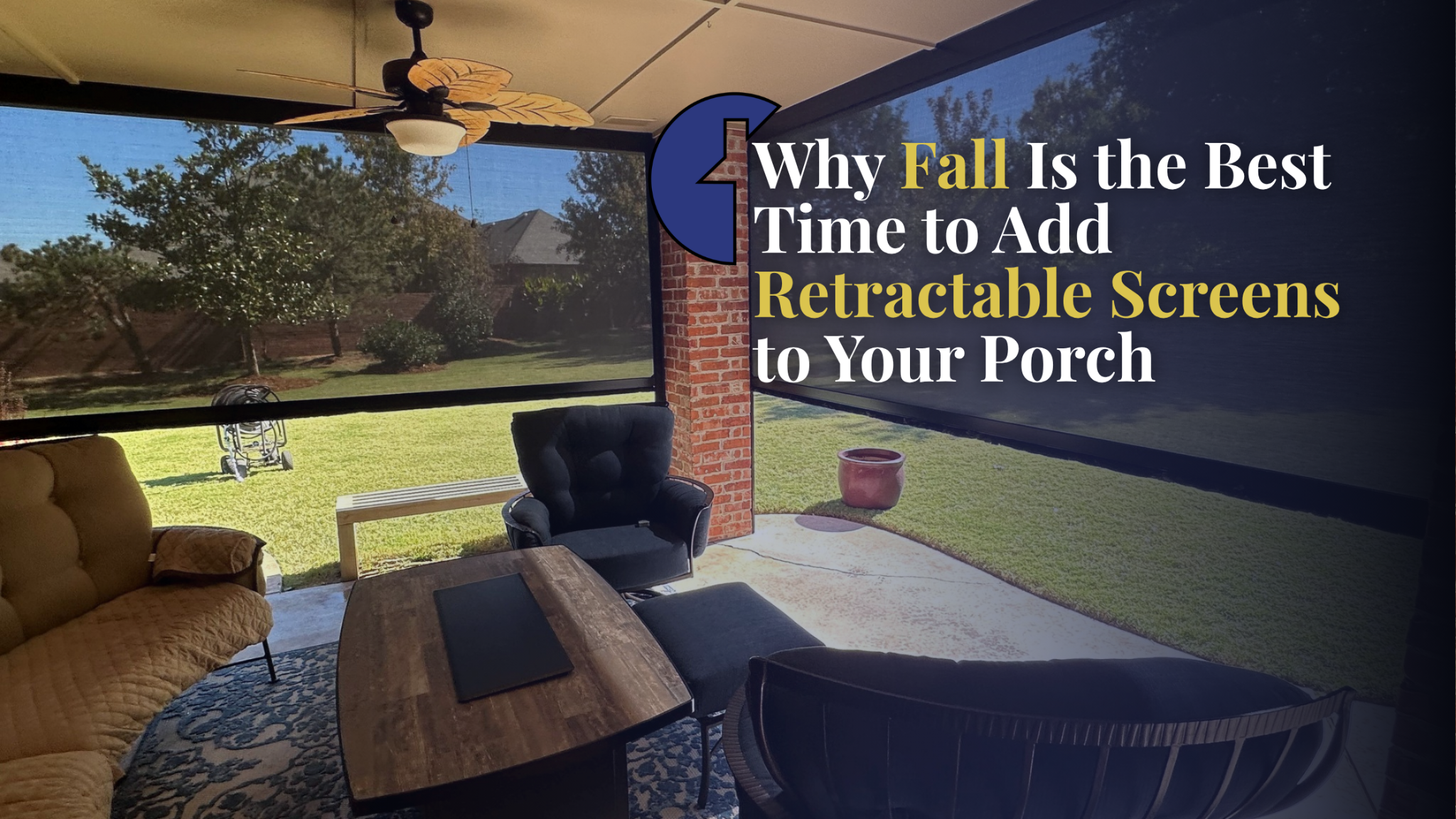

There is one week in October when your porch is the best room in the house. Add a retractable screen, and that week can stretch a whole lot longer. The air turns dry, the light comes in low and gold across the yard, and for about four days everything is exactly right.
Then the wind picks up. Leaves collect in the corners. The evenings get short. By the second week of November the cushions are in the garage and the porch goes back to being a place you walk through on the way to the car.
Most homeowners across Montgomery County and Bucks County treat that as the weather’s decision. It isn’t. It’s a design problem, and October is the right month to solve it.
A porch is already most of the way to being a room
Walk out onto yours and look at what’s already there. A roof. A floor. Posts or columns at regular intervals. Two or three sides that are mostly open air.
That is a room with its walls missing. Everything a builder would charge you to construct — the structure, the foundation, the cover overhead — you already own. What you don’t have is control over the openings, and that is the only part left to solve.
A retractable screen is a wall you can decide about. It drops when you want the space closed, and it disappears into a housing at the top of the opening when you don’t. No permanent enclosure. No boxing in the view you bought the house for. On a Sunesta Sentry system, the fabric can be insect mesh, solar mesh, or an opaque privacy fabric.

What fall actually asks of a porch
Summer asks one thing of an outdoor space: shade. That’s a straightforward problem and a motorized retractable awning solves it in about ten seconds.
Fall asks four things at once, and this is why porches empty out in October while the temperature is still perfectly pleasant.
Wind. A 62-degree afternoon is beautiful. A 62-degree afternoon with a steady wind across an open porch is a jacket-and-go-inside afternoon. Wind, not temperature, is usually what ends the evening.
Rain that arrives sideways. Your roof handles rain falling straight down. It does nothing about rain blowing in at an angle, which is most of the rain we get here between October and December.
Leaves and debris. An open porch in a neighborhood with mature trees becomes a collection point. Every gust deposits more, and by November you are sweeping before you can sit down.
Insects that have not read the calendar. Mosquitoes stay active into the first hard frost. And in this corner of southeastern Pennsylvania we have the spotted lanternfly to contend with as well — the adults are at their most visible and most persistent in exactly these months, and they land on everything.
Retractable screens answer all four. That is the whole argument, and it is a fall argument rather than a summer one.
Why the installation belongs in fall rather than spring
Here is the part most homeowners get backwards. They notice the problem in October, decide to do something about it, and then wait for spring — which is the worst possible time to start.
You measure in the weather you’re solving for. When Paul walks your porch in October, he is standing in the conditions the screens have to handle. He can see which opening the wind actually comes through, where the afternoon sun lands at 4 p.m. in the fall rather than at 4 p.m. in June, and which side collects the leaves. That is a different set of answers than you get from a walkthrough in May, and it changes the fabric selection, the drop height, and which openings get screened at all.
You choose fabric in honest light. Twenty-five fabric selections and five powder-coated frame colors is a good problem to have, but it’s a decision made better against your actual siding, your actual trim, and the light you’ll be sitting in. Fall light is unforgiving in a useful way.
You are not spending your own season waiting. Screens ordered in October are screens you are using the first warm weekend of April, without a single week of the good months lost to measurement, fabrication, and installation. The alternative is deciding in April and watching May go by.
What you’re actually getting
Every Sunesta porch screen is custom-built to the opening rather than trimmed down from a stock size. The Sentry handles widths up to 26 feet with drops to 16 feet, which covers nearly any residential porch bay in one piece, and wider openings get multiple screens run from a single remote.
Control is your choice. Motorized systems run from a wireless remote or a wall switch, integrate with home automation you already have, and can take wind and sun sensors that retract the screen on their own when the weather turns. Manual operation is available where a motor isn’t wanted or isn’t practical.
Coverage is up to 15 years on frames, up to 10 years on fabric, and up to 5 years on motors — ask Paul Construction for details on your specific model, since terms vary by product. And the workmanship behind the installation carries our Lifetime Workmanship Guarantee, the same as everything else we build.
When a porch screen isn’t enough
Sometimes the honest answer is that screens solve three of your four problems and you want all four solved.
If what you actually want is a porch you can sit in on a 30-degree January morning with coffee, that is a Remote Space — a screen wall system paired with ductless mini-split heating and cooling, which turns the porch into a genuine all-season room. It’s a larger project and a larger investment, and it’s the right one for some houses.
The useful thing is that the two aren’t a fork in the road. Porch screens installed correctly now don’t have to be undone later if you decide to go further. Ask about both and price them side by side. Paul will tell you which one your porch is actually asking for.
Come look at it with us
Thirty years of building outdoor spaces across Greater Philadelphia and South Jersey has taught us that the answer is always specific to the house. Yours has a particular roofline, particular openings, particular weather coming from a particular direction.
We come out, we look at it with you, and we draw the plan by hand for your porch rather than pulling something off a shelf.
Instantly Schedule Free Estimate! Or call 610-287-1623 — ask for Paul.