

Philadelphia summers are not subtle. By mid-July, a patio or deck with no overhead summer shade is not really an outdoor room. It becomes a surface you cross on your way to somewhere else. The afternoon sun angle, the humidity that makes every degree feel heavier, and the radiant heat rising from stone or composite decking long after the sun dips can add up fast. An outdoor space that feels comfortable on a perfect spring day can be genuinely unusable by 2 p.m. in July.
The good news is that this is a solvable problem. The question is what kind of shade solution fits your space, your usage patterns, and what you want from your outdoor living area long-term. This blog will walk you through two main approaches, a retractable awning or a permanent roof structure, to help you think through which option, or which combination of options, makes sense for your home.
Why Summer Shade Planning Matters More Than Homeowners Expect
Most people think about summer shade when the problem is already uncomfortable. They’ve owned the deck or patio for a season or two, enjoyed it in spring and fall, and discovered that July turns it into something they avoid. At that point the question shifts from “would it be nice to have shade?” to “this space isn’t really working.”
Two things drive summer outdoor discomfort in the Greater Philadelphia area: direct overhead sun and radiant heat. Direct sun is the obvious one — a strong UV afternoon in July can push surface temperatures on a dark composite deck or a brick patio well past air temperature. Radiant heat is the sneakier problem. Hardscaping and decking absorb heat during the day and release it for hours afterward, so a patio that feels warm at 7pm often has nothing to do with the sun. It’s the surface you’re sitting above.
Overhead summer shade addresses the first problem directly. A well-placed awning or roof structure reduces the direct solar load on both the people in the space and the surface beneath them, which in turn reduces radiant heat retention. The result isn’t just comfort — it’s a space that stays genuinely usable from late morning through early evening rather than a window of pleasant hours on either side of the hottest part of the day.
UV protection is a secondary benefit worth mentioning. UV-blocking shade reduces skin exposure for everyone spending time outdoors — something that matters especially for families with young children or anyone who spends significant time outside.
Option One: Retractable Awnings
Shade When You Need It, Open Sky When You Don’t
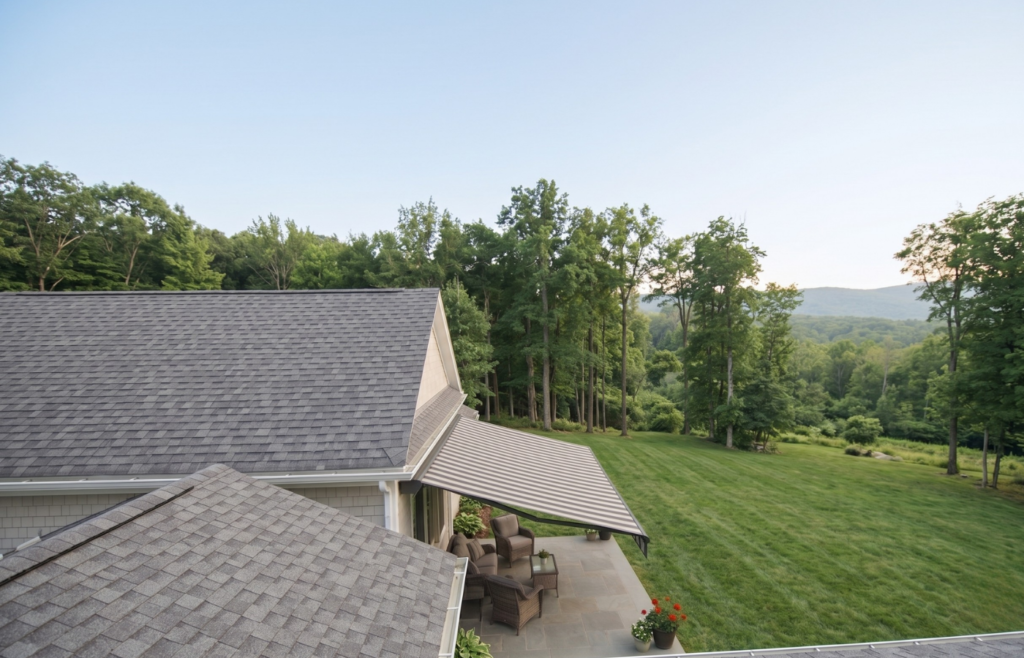
A retractable awning is the most flexible summer shade solution available for a patio or deck. It deploys when you want coverage and retracts fully when you want open air — no permanent visual impact, no blocking the view when the light turns golden in the early evening, no issues during winter when a fixed structure can accumulate snow load.
Retractable awnings from Paul Construction & Awning are exclusively Sunesta systems — custom-sized from the factory to your specific space, motorized or manual, with over 100 solution-dyed acrylic fabric options. Sunesta is the only retractable awning brand that is Miami-Dade hurricane certified, which speaks to the structural engineering of the arm and frame system, not just the fabric. That matters in the Greater Philadelphia area, where summer storms can arrive fast.

A few things worth understanding when shopping for retractable awnings:
Custom sizing is everything
An awning that doesn’t cover the right area of your patio — that leaves the afternoon sun hitting the table, or doesn’t reach far enough to shade the seating area — hasn’t solved the problem. Sunesta systems go up to 40 feet wide and offer substantial projection, but getting the coverage right requires measuring the actual sun path across your specific space. That’s part of what Paul Construction does during the design phase.
Motorized vs. Manual
A motorized awning operates with a remote or wall switch. For most homeowners, that means they actually use it — it takes two seconds and no physical effort to extend or retract. A manual awning cranks out by hand, which works fine for predictable, longer sessions but gets skipped when the sun shifts mid-afternoon or a quick pop-up storm comes through. If easy deployment means you’ll use it more, motorized is worth it.
Wind Densors
Motorized awnings can be paired with wind sensors that automatically retract the awning when conditions exceed a threshold. Given how fast summer thunderstorms build in the Philadelphia area, this is a meaningful protection feature for an awning left unattended during the day.
Warranty
Sunesta offers up to 15 years on frames, up to 10 years on fabric, and up to 5 years on motors — ask Paul Construction for details on your specific model. These aren’t ambiguous claims; they’re tiered by product and documented at purchase.
Paul Construction self-describes as the largest retractable awning installer in the U.S. and has been installing Sunesta systems in Greater Philadelphia and South Jersey for over 30 years. Every installation is handled in-house — no third-party crews — and every awning is custom-specified for the property, not pulled from an inventory of standard sizes.
Option Two: Permanent Roof Structures
Full Coverage, Year-Round
A retractable awning is the right call when flexibility is the priority. A permanent roof structure is the right call when you want full, reliable coverage that doesn’t depend on someone pressing a button.
Covered patios and post-and-beam structures create an architectural overhead that transforms an open deck or patio into something closer to an outdoor room. The roof handles not just sun but rain — you can eat outside during a light summer shower, something no awning does reliably. A properly engineered roof structure also creates a mounting point for ceiling fans, outdoor lighting, and eventually heating elements that extend the space into fall.
The trade-offs are real. A permanent structure costs more than a retractable awning, requires permitting in most municipalities in Montgomery and Bucks Counties, and adds a visual element to your home’s exterior that you’re committing to long-term. Done well, it adds significant value. Done without thought for the architectural relationship to the house, it can look like an afterthought.
Paul Construction handles the entire process in-house: design, engineering, permitting, and construction. Paul J. Salassa, the founder, is a trained architect — every roof structure project starts with hand-drawn plans specific to that property, not a generic blueprint adapted from a template. That means the structure is designed to match the home’s roofline, materials, and scale in a way that looks like it was always there.
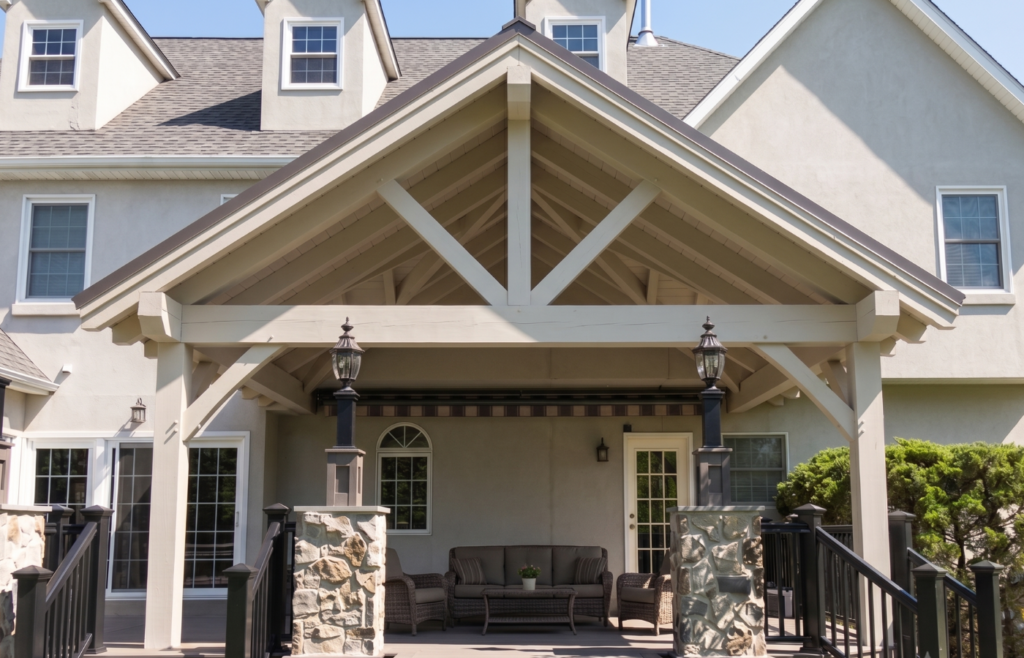
Common configurations include:
Post and beam patios
A classic approach — heavy timber posts support a beam-and-rafter roof, often with open rafters that allow some light through while providing substantial summer shade and rain coverage. Materials can match the home’s existing palette.
Covered patio additions
A solid roof structure built off the back of the house, often with a ledger connection to the existing roof framing. Provides full weather coverage and integrates with the home structurally. Requires the most permitting work but produces the most seamless result.
Pergolas with integrated shade
A pergola’s open lattice top doesn’t provide full shade on its own — but a pergola can be built as the structural framework for a retractable canopy or fixed fabric panels that do. This hybrid approach gives you the architectural look of a pergola with meaningful functional shade.
When to Use Both
The most functional outdoor spaces often use both approaches in combination. A permanent roof structure over the main dining or seating area provides reliable, all-weather coverage. A retractable awning extends the covered zone on hot afternoons or adds shade where the sun angle requires it at different times of day. Retractable screens can close off the sides when late-day wind picks up or evening bugs become an issue — without permanently enclosing the space.
The design of this kind of layered approach is where Paul Construction’s background in architecture and outdoor living shows. It’s not a matter of installing the largest possible shade structure — it’s figuring out how the sun moves across your specific space across the day and the season, what the space is being used for, and what kind of coverage makes it genuinely more usable rather than just technically shaded.
Why the Installation Process Matters
The gap between a good summer shade solution and a frustrating one often comes down to the installation, not the product. An awning mounted on the wrong wall, at the wrong pitch, or without adequate fastener depth for the substrate is a product that gives you problems. A roof structure framed without proper attention to load paths or without permits is a liability.
Paul Construction’s process starts with a site visit. The design — for an awning, a roof structure, or a combination — is drawn specifically for that home. Permitting, where required, is handled by the Paul Construction team, not passed off to the homeowner. The installation crew is in-house and experienced with both Sunesta systems and custom structural work. The job isn’t finished until everything works correctly, the space is clean, and Paul’s Lifetime Workmanship Guarantee is in place.
That guarantee covers workmanship — the installation quality — for the life of the home. Manufacturer warranties on the Sunesta products apply separately. Together, they mean you have protection at every layer of the project.
Ready to Make Your Outdoor Space Work in July?
The best time to start is now — Paul Construction typically schedules design consultations quickly, and the installation timeline gets longer as summer progresses and project queues fill up.
Instantly Schedule Free Estimate or call 610-287-1623 and ask for Paul.